
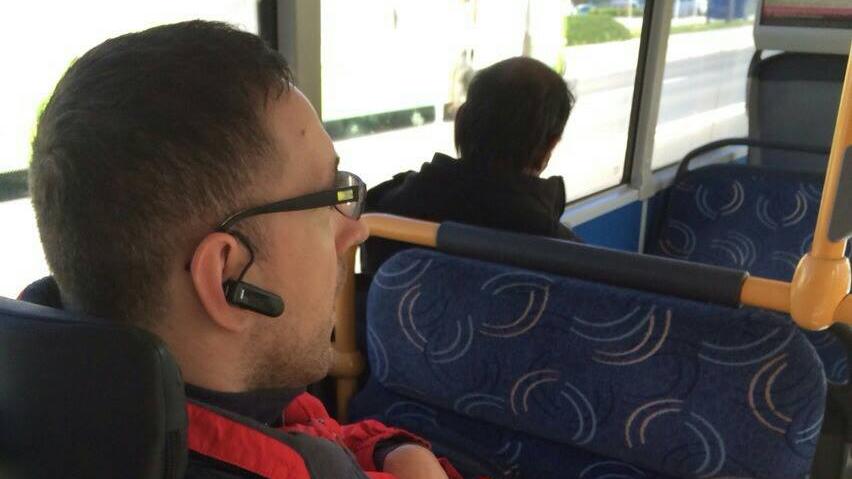

I admit that I can be unconventional and stubborn, sometimes even pessimistic. Yet that caution has helped me reach where I am today and occasionally show, through an ordinary life, what is possible. That is why I am unsure what World Cerebral Palsy Day, which we observe today, truly achieves. To be honest, I feel the same about many other “special days”. They exist because someone decided that a subject deserves attention. This post is part of that conversation too. But such days rarely lead to concrete action that improves someone’s future. We talk a great deal about inclusion and equality, yet a special day can make us seem even more separate: the subject receives attention for one day, while the same barriers remain for another year.
But this time my intention is not simply to criticize. World Cerebral Palsy Day exists, and we have it because we are a large global community and apparently this is how our voice is heard. With that in mind, I congratulate us all. I understand why we have it, but I do not know whether this day is really devoted to that purpose. So I would like to add something here, so that at least once we can add a few thoughts to this day and it will not be merely a day for CP.
It happens that people know where I work and what I do; apparently they are happy about it and supportive. At the same time, they see the wheelchair and me stammering at the beginning of a speech because my muscle tension rises with activity, or whatever exactly happens. I understand that this is disturbing, and I will tell you openly and honestly that it disturbs me too. But I would like to explain that this is a momentary reflex, a spasm, or whatever you want to call it, which is visible only from the outside. It does not cause me pain or fatigue and does not affect my abilities, which, as you can see from this writing, can be perfectly clear. It is only that my speech is… the way it is…
I know that with CP people often assume that a person has some kind of cognitive deficit because they happen to be sitting in a heavy, wide wheelchair and are quite extensively supported from all sides. Yes, perhaps it does not look nice… But CP, even though it is a brain injury, does not always mean intellectual impairment or some kind of weakness. Cerebral palsy can indeed mean a broad range of difficulties, but that is never inevitable and it is not the same for everyone.
So let us first briefly explain what cerebral palsy is. Cerebral palsy (CP) is a collective term for permanent disorders of movement and posture, and possibly also of mental abilities, that arise from an irreversible injury to or abnormal development of the brain during the early period of life (most often before, during, or shortly after birth). The brain injury itself does not worsen (the condition is non-progressive), but its consequences—for example muscle stiffness, contractures, pain and fatigue—can change over the years. CP is the most common cause of motor disability in children.
All of this is possible, but it differs greatly from individual to individual. I will not go into detail here, however, because I would like to talk about myself. As you know, there are also people with CP who live independently, have gone through school and work in their professions. Of course, we need a great deal of additional support and have many difficulties of our own. But the essence of inclusion is precisely that we solve some of our difficulties ourselves and are also responsible for them ourselves. We disabled people are often our own greatest obstacle as well. But if we want to live like everyone else at all costs, then we should also deal with that in our own way, within the limits of what we can manage. I really do not want to attack or insult anyone, but sometimes excessive concern from outside for those of us who are capable of doing something is more of a burden than a help.
A recent example happened to me. I was arranging something personal with someone, and we worked through many details by phone; everything was going smoothly. We then agreed to meet, so I went to the location.
I get there, and we are supposed to talk about the matter itself. But the first thing the person asks me, in a well-meaning way, is:
“Jaka, is it very tiring for you when you have to drive back and forth?”
I probably find it difficult to explain everything, and I cannot blame this person for asking because they do not know me very well. But I do resent the question when it comes from someone who knows me well and supposedly understands me well.
So, in very brief: If I am in a wheelchair, twisted and supported from all sides, that does not necessarily mean that every movement is an effort for me. I came somewhere and am talking to someone about business. If the other person is there for business, let us talk with me about that—not about how difficult it is to find the right van or physiotherapist for my needs. Yes, of course—some people cannot do as much as I can. And I too may be tired after a meeting… and need help with some task. But that will not necessarily be a consequence of my disability. After all, a boss does not ask people who walk whether it “wears them out,” does he? It may happen that they cannot manage something, while I can…
I only want to say that some of us disabled people are not struggling with the fact that we have to go to the bank, go shopping or go to a location to sell a house. It can also be tiring and a hassle, just as it sometimes is for everyone else. But this is my intimate, personal problem. If I need help or advice, I will raise it and say so. What really “wears me out” are entirely different problems from what you see—as I believe, with good intentions—as a problem if you cannot imagine being in my shoes. But it is my problem.
At every level, we want inclusion, and rightly so. But inclusion is not simply a matter of someone else bringing a disabled person to an event. In my modest opinion, a person with a disability first lives inclusion themselves. Or perhaps they remain more within their own circle and do not live it. To each their own. When I arrive somewhere on my own initiative and out of my own interest, that is inclusion which is no longer merely a concept, but life. I do not think that at that moment some third person needs to worry about how I got there, what I had to do, how I feel, or whether I am there gladly or not. If I came, I am not there for inclusion itself, or because something about disabled people is happening. Maybe I am there for the event, the music, good food, or simply someone. Nor do I need to be admired or have it emphasized that this is inclusion, simply because not all people with CP can honestly manage this. If it were too exhausting or a hassle, I would not have come. If I am somewhere even though it is a hassle for me, then at my age and with my mind I am probably to blame myself? Of course I will also complain to someone close and anger them. All of this is inclusion. And I am also writing about this to show you that I can judge for myself. Inclusion is not a concept from a doctor’s or social worker’s office. Inclusion is life itself—not without difficulties, not without unsolvable puzzles, but still simply life. We, the very advocates of inclusion, often forget this when we should be saying it to those same doctors, social workers, assistants, therapists, families and others. We also have a lot to do ourselves. The paradox is that this too is inclusion.
I will dare to say that disabled people are not struggling with having to do something in our own way. We struggle with others assuming in advance that something is much harder because you do not walk. Sometimes yes, sometimes no. We struggle with roads not being properly arranged, with bad weather. Just like everyone else. Or perhaps I have oversimplified and am wrong too. Judge for yourself. But this is how inclusion should work for everyone. And often it does not.
CP itself is such a broad spectrum of different needs that sometimes, for those of us with CP, it seems even more that everything looks terribly difficult. Because we sit awkwardly, because an arm is twisted and a leg is stiff, because speech is hard to understand. Yet the car registration is in my name, and so are the bills… So something is possible? CP is precisely a good example of all that is possible, even when the beginnings are unclear and difficult.
All of us together must realize that inclusion is something we can only live, not something that needs to be planned in detail, perhaps doing everything else except living!
Until then, however, we will have our World Day and other people will simply talk about all of us (and we will talk with them, included), about what they think we need, while we will keep wanting inclusion from somewhere outside ourselves. But that alone will never be enough.