
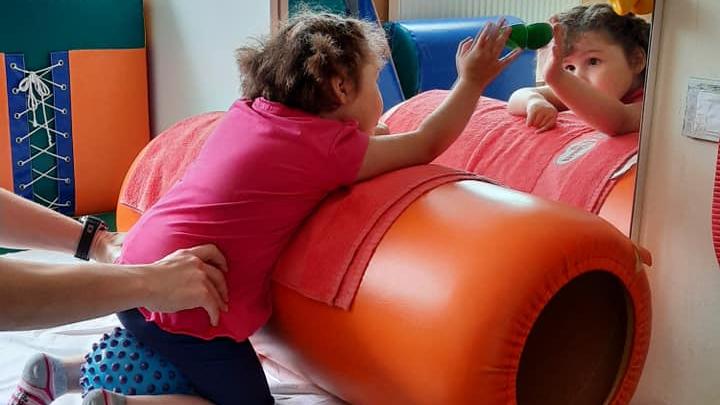

The title and image of this post may seem unusual or provocative. Both were chosen deliberately, and the image is published with permission. When discussing access to therapy, it helps to explain a few important points. Many people do not realise how much physiotherapy still helps me. I have already written about how difficult it is for an adult to find the right therapist and treatment. Let me now explain what people like me actually need. It may not seem obvious at first, which is precisely why this support is so difficult to obtain.
Specialized and regular physiotherapy treatment, especially in recent years, is no longer for me merely something I would indulge in because it happens to feel good. No, it is something that has accompanied me closely ever since childhood and is of key importance if I am to move. That is why it matters. It is a large part of my life and movement, although of course it is not only that. At the same time, we can immediately clarify that cerebral palsy (CP), which is a brain injury from childhood, does not itself worsen according to some clear pattern, but without specialized and high-quality neurophysiotherapy treatment things would be all the worse, because the various factors that accompany CP and become amplified within it would ensure that I sat even more crookedly, spoke with even greater contraction and even more difficulty, and in the end something unexpected would simply happen. Physiotherapy, or rather neurophysiotherapy treatment, helps here because these episodes of my “tightening up” are connected to a neurological diagnosis.
I am not an expert, so I explain these matters in a simplified way and speak mainly from my own experience. That is enough to make the central point. Readers who know more about the subject will, I hope, forgive the simplification.
Things often begin to get stuck already at the point where someone asks what a therapist is even supposed to do with me, since apparently I am not going to walk and, at my age, there may be no visible progress. Many people and therapists do try hard to understand, because they can at least see that I am disabled and therefore must need something, but in truth many professionals do not know what to do with me either, simply because I am an adult and it is physically harder to work with me than with a few-month-old baby or a child. Many people do not understand this, but I can clearly say that nothing could be further from the truth. I may indeed never walk, crawl independently, or roll over at my age, but because of expert treatment every other activity of mine, and every activity of assistants who help me, becomes that much easier and of better quality. So progress does exist; only the angles of vision and the various units of measurement change a little over the years. We soon realize as well that all this affects not only immediate physical well-being, but to a great extent mental health too.
If we can somehow explain that such treatment is not merely welcome but of crucial importance, the matter then almost stops completely when I benevolently explain that I basically need almost the same treatment as babies or children with developmental difficulties who, like me, were born prematurely and so on, and not merely therapies for adults… We all understand that physiotherapy for adults exists… In recent years there has been more talk about therapies for children with disabilities, and that too becomes clear… We know there is also a branch of physiotherapy for neurological conditions… I may again be simplifying somewhat, but I only want to show a real problem, one that is not visible in all the media. In short, at the phrase “neurophysiotherapy for a neurological condition”, someone kindly assumes that this is exactly what I am looking for. Jaka is an adult, he has a neurological condition, and the puzzling equation has been solved. And if we also manage to learn that therapists have additional training and truly master the field, then it will probably be good for Jaka as well, and we have solved the riddle.
That would sound sensible and logical. But the devil is in the details.
Over the years I myself have noticed that any guided movement is certainly welcome for me and feels good, but I have also noticed that some of the effects we mentioned above are not even visible to others. One aspect is simply that I feel good in my own skin, and that somehow came naturally. But over the years of growing up it was also necessary to look for something that would help, at least a little, the people around me as well, so that they could help me more easily in everyday life. I began to understand my condition and, with it, the fact that it is not enough for me merely to feel good because once a week I went to physiotherapy. If, right after that therapy, I sit back down in my wheelchair in exactly the same crooked position, it seems that far too little has been done. That frightened me. Although we had indeed done some good things, I lacked the feeling that someone truly understood and could also see what I myself was then feeling. Then I remembered how this kind of work had been done with me in childhood. At first I thought it was not comparable, because I am older now, the body is different, and so it seemed. Even now there was neurological treatment, but it was different. Different by just enough that, as a layperson, you do not know exactly what should be done, yet the serious effect is in fact missing. And I simply did not reconcile myself to the idea that this is just how things are for adults.
Then you continue observing yourself. You are older, but the movement pattern of a baby, which should have disappeared by six months of age, is still present in you. At first it may even seem funny that, as an adult, stubborn as you are, you go back to a children’s therapist. But the baby’s movement pattern is there. They may say, “We do not work with adults,” yet they understand that pattern differently and work on it with you differently than a physiotherapist who knows you only as an adult.
Later I therefore began searching for “children’s physiotherapists” who would work with me, in relation to the difficulties connected with CP, in a way as close as possible to how work was done in childhood. That is a special challenge for everyone, because what I explained above is also hard to understand. But the pattern remains, and special knowledge is required. We still need a whole range of solutions, but as a person with congenital CP, perhaps I first need this, even though it brings new challenges. And so I began doing most of my exercise with trained therapists from pediatric departments, and at times I was even forced to teach a thing or two to someone myself.
Today I work with an experienced neurophysiotherapist, and together we really achieve a great difference. After every therapy session my personal assistant, as a layperson, immediately notices a major difference in the way I sit, although to an outside observer it may remain almost completely hidden. So we have done something after all?
What I have said is not intended as criticism of anyone, least of all of other diligent therapists who in any way work with adult neurological patients and have experience and specialized knowledge in this field. Their work is necessary and their knowledge praiseworthy. Years ago I myself worked with different therapists, and each one brought good things. I also understand those who work with children and find it harder to manage my patterns and posture. A human being is simply a combination of an enormous number of possibilities. But CP itself, together with a few associated problems, is very specific, and so is the treatment. If a therapist fundamentally understands the condition, a great deal can be done. So let us say clearly that therapy for an adult patient after a stroke is not the same as therapy for that patient’s peer with CP, which is also a neurological condition, but one that most often originates in childhood. Of course there are many similarities, but from my own experience I know that it is not entirely the same.
Let us try to explain this with due care. A premature baby is admitted for treatment because of risk factors by highly trained physiotherapists who have knowledge and experience in developmental-neurological treatment. The child is often followed by a whole team of professionals who monitor the child’s motor development, if we simplify matters here and limit ourselves only to physiotherapy. If a child with some injury is only a few months old and we want that child to develop properly, then it is surely clear that treatment for a baby cannot be the same as treatment for an adult after a stroke, is it not? Perhaps in both cases there is an injury to the brain and nerves, but that is probably where the similarities in detail come to an end. In a child the symptoms appear differently, and therapy has a different effect because the body is developing. It becomes obvious to everyone that for a developing child it will not be enough merely to relax the parts of the body that are visibly contracted; one must understand the whole picture much better and have the necessary knowledge and experience for it.
Now you can understand why I am looking for, and why I speak about, “children’s specialized physiotherapy” for my condition. There really is a visible difference, and I recommend something similar to everyone in a similar situation. For me, massage alone or some similar kind of loosening exercise is simply not enough. That is because, in an interesting way, certain infant movement patterns have remained and still accompany me today. So it is advisable to manage these things with approaches similar to those used for a baby. There are many similarities one would not expect… I simply cry a little less during therapy…